Felony vs Misdemeanor Orlando: Felony vs Misdemeanor in Orlando: Key

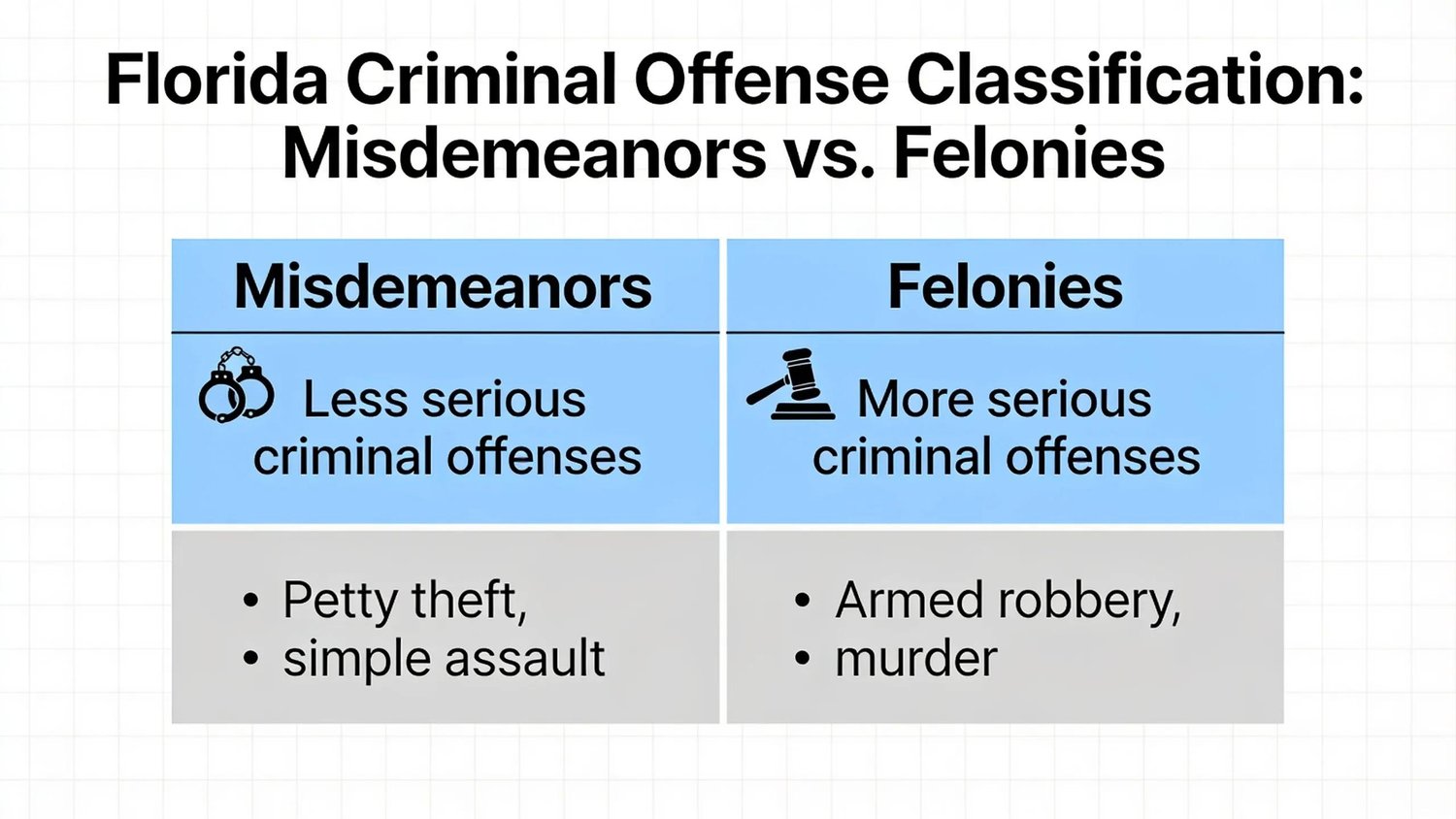
When it comes to felony vs misdemeanor orlando, felonies. Misdemeanors in Orlando differ significantly in severity, with felonies carrying prison sentences of one year or more. Misdemeanors resulting in jail terms of less than one year. The AM Lawyer, P.A., based in Orlando, FL, handles both classifications. Felony convictions also strip individuals of voting rights and firearm ownership privileges.

Felonies and misdemeanors in Florida differ by one critical threshold. Offenses carrying a maximum of 364 days remain misdemeanors handled in county court. Crimes reaching 365 days or more become felonies prosecuted at the state level, risking state prison time, lasting civil rights restrictions. Long-term consequences for employment and freedom.

Florida law divides criminal offenses into two primary categories: misdemeanors and felonies. Misdemeanors carry lighter penalties, while felonies result in harsher fines and longer incarceration. Orlando defendants facing charges in the 9th Judicial Circuit encounter distinct legal consequences depending on classification, making early consultation with The AM Lawyer essential to protecting their rights.

Key Takeaways

  • Florida classifies crimes as misdemeanors or felonies based on maximum sentence length and severity.

  • Misdemeanor convictions result in up to 364 days jail time served in county facilities.

  • Felony convictions carry 365 days or more prison time served in state facilities.

  • The AM Lawyer, P.A. in Orlando provides legal representation for both misdemeanor and felony charges.

Florida classifies crimes as misdemeanors or felonies based on maximum sentence length and severity.

Misdemeanor convictions result in up to 364 days jail time served in county facilities.

Felony convictions carry 365 days or more prison time served in state facilities.

The AM Lawyer, P.A. in Orlando provides legal representation for both misdemeanor and felony charges.

Why Does Your Charge Classification Matter in Orlando?

Felony vs misdemeanor Orlando classification is one of the most consequential distinctions in Florida criminal law. Nearly all criminal offenses in Florida fall into one of two broad categories — misdemeanors or felonies — and the category assigned to a charge shapes every outcome that follows. cite-1

The stakes extend far beyond the courtroom. A charge classification affects freedom, employment prospects, and civil rights long after a case reaches its conclusion. cite-2 Orlando residents facing criminal allegations often underestimate how deeply a single classification decision ripples through their professional and personal lives.

What Are the Long-Term Consequences of a Felony Charge in Orlando?

Felony consequences Orlando reach well beyond any sentence served. A felony conviction can restrict civil rights, limit job opportunities, and follow a person through background checks for years. The damage accumulates quietly — long after the case is closed.

How Do Misdemeanor Penalties in Orlando Differ From Felony Penalties?

Misdemeanor penalties Orlando and felony penalties occupy entirely different tiers of the Florida criminal justice system. The two classifications carry distinct consequences across multiple dimensions:

  • Charge severity: Misdemeanors represent less serious offenses; felonies represent the most serious

  • Incarceration risk: Misdemeanor sentences are served locally; felony sentences involve state prison

  • Lasting impact: Felony convictions affect civil rights and employment in ways misdemeanor convictions typically do not
Charge severity: Misdemeanors represent less serious offenses; felonies represent the most serious

Incarceration risk: Misdemeanor sentences are served locally; felony sentences involve state prison

Lasting impact: Felony convictions affect civil rights and employment in ways misdemeanor convictions typically do not

The classification assigned at charging is not always final. Experienced legal counsel can challenge the basis for a charge, negotiate reductions, or contest evidence before a case proceeds. The AM Lawyer, P.A. provides aggressive criminal defense for both misdemeanor and felony charges throughout Orlando. The broader 9th Judicial Circuit, intervening at the earliest possible stage to protect clients' rights and long-term interests.

How Does Florida Define Misdemeanors and Felonies?

Florida law divides criminal offenses into two primary categories — misdemeanors and felonies. Based largely on the severity of the alleged conduct and the potential sentence attached to it. Understanding the distinction matters enormously for Orlando residents. The classification of a charge determines where a case is heard, how long a defendant may be incarcerated. What long-term consequences follow a conviction.

The core dividing line is straightforward. Misdemeanor penalties Orlando defendants face are capped at up to one year in county jail. Felony consequences Orlando defendants face begin at one year and extend into state prison. A fundamentally different and far more serious outcome.

What Is the Exact Line Between a Misdemeanor and a Felony in Florida?

One single day of potential jail time separates the two classifications. A charge carrying a maximum of 364 days is classified as a misdemeanor, with jail time served locally in county facilities. A charge carrying a maximum of 365 days or more crosses into felony territory, bringing state prison exposure. Consequences that extend well beyond the sentence itself.

How Do Misdemeanors and Felonies Compare in Florida?

The table below summarizes the key structural differences:

Factor

Misdemeanor

Felony

Maximum potential sentence

Up to 364 days

365 days or more

Where jail time is served

County jail

State prison

General severity level

Less serious

More serious

Factor

Misdemeanor

Felony

Maximum potential sentence

Up to 364 days

365 days or more

Where jail time is served

County jail

State prison

General severity level

Less serious

More serious

Felony vs misdemeanor Orlando cases are not interchangeable. Misdemeanors are generally considered less serious offenses and carry less severe penalties. cite-1 Felonies, by contrast, carry sentences that start at one year in state prison and can escalate significantly depending on the degree of the charge.

Orlando residents facing either classification benefit from retaining experienced criminal defense counsel early. The AM Lawyer, P.A. serves clients throughout Central Florida and offers free consultations to help individuals understand exactly where their charge falls and what is at stake.

What Are the Misdemeanor Penalties in Orlando?

Misdemeanor penalties in Orlando are less severe than felony penalties, but a conviction still carries real consequences that affect daily life. Defendants convicted of misdemeanor offenses serve any jail time in a county jail — not a state prison — which is a meaningful distinction in terms of environment, proximity to family, and length of confinement. cite-3

How Does the Misdemeanor Court Process Work in Florida?

Florida misdemeanor cases move through the court system differently than felony cases. When a person faces a misdemeanor charge, there is no preliminary hearing and no jury trial. Sentencing is determined directly when the defendant appears before the judge. That streamlined process sounds simpler, but it leaves little room for error. Defendants who appear without experienced counsel risk an unfavorable outcome with no second chance before a jury.

Where Is Jail Time Served for a Misdemeanor Conviction?

Jail time for a misdemeanor conviction is served locally, in a county jail rather than a state prison facility. That distinction matters practically. County jails are closer to home, and sentences are shorter by definition. Even so, any period of incarceration disrupts employment, housing, and family stability — consequences that extend well beyond the courtroom.

The key differences between misdemeanor and felony case handling in Orlando include:

  • No preliminary hearing for misdemeanor charges

  • No jury trial — a judge determines the sentence

  • County jail, not state prison, for any incarceration

  • Faster resolution, but fewer procedural safeguards for the defendant

No preliminary hearing for misdemeanor charges

No jury trial — a judge determines the sentence

County jail, not state prison, for any incarceration

Faster resolution, but fewer procedural safeguards for the defendant
The AM Lawyer, P.A. handles misdemeanor defense for clients throughout Orlando and the broader Central Florida region, including Orange, Osceola, Seminole, Lake, and Volusia counties. The firm offers free initial consultations and bilingual service in English and Spanish, ensuring that defendants across Central Florida understand their rights and options before stepping into a courtroom. cite-4

What Are the Felony Consequences in Orlando?

Felony consequences in Orlando reach far beyond the courtroom. Felony convictions carry sentences starting at one year in state prison and extend, at the most serious end of the spectrum, to the death penalty — a range that dwarfs anything a misdemeanor charge produces. cite-5

Unlike misdemeanor proceedings, a felony case exposes the accused to incarceration while awaiting a jury trial. cite-3 That pretrial detention alone disrupts employment, housing, and family stability before a single verdict is reached. The stakes are immediate and severe.

What Long-Term Effects Does a Felony Conviction Have?

A felony conviction reshapes life well after the sentence ends. Civil rights, job opportunities, and personal freedom all suffer lasting damage that follows a convicted individual for years. Employers conduct background checks, licensing boards review criminal histories, and certain civil rights. Including voting and firearm ownership — are affected by a felony record in Florida.

The consequences are not temporary. They compound over time, narrowing options in ways that a misdemeanor record typically does not.

How Does a Felony Case Differ From a Misdemeanor in Court?

The procedural differences are significant. Felony cases involve jury trials and the possibility of pretrial incarceration, while misdemeanor cases are resolved without those mechanisms. That distinction means felony defendants face a longer, more complex legal process with higher exposure at every stage.

Factor

Misdemeanor

Felony

Trial type

No jury trial

Jury trial

Pretrial detention

Generally not held

May be incarcerated pending trial

Sentence range

Up to 364 days, county jail

One year to death penalty, state prison

Long-term civil rights impact

Limited

Significant and lasting

Factor

Misdemeanor

Felony

Trial type

No jury trial

Jury trial

Pretrial detention

Generally not held

May be incarcerated pending trial

Sentence range

Up to 364 days, county jail

One year to death penalty, state prison

Long-term civil rights impact

Limited

Significant and lasting

Navigating this process without experienced counsel is a serious risk. The AM Lawyer, P.A. defends clients facing [Misdemeanor vs. Felony Charges in Florida: What's the Difference. Why It Matt](https://www.theamlawyer.com/misdemeanor-vs-felony-charges-in-florida-whats-the-difference-and-why-it-matters-for-your-future/) throughout the 9th Judicial Circuit, applying direct familiarity with local courts, prosecutors, and judges to build case-specific defense strategies. Free consultations are available around the clock, with bilingual staff on hand to serve Orlando's diverse communities.

How Do Felony and Misdemeanor Cases Proceed Differently in Court?

The procedural path for a felony vs misdemeanor Orlando case diverges sharply from the moment charges are filed. Misdemeanor cases in Florida are resolved before a judge alone, with no jury trial and no preliminary hearing. cite-3 Felony cases, by contrast, carry the full weight of state court procedure. Including the possibility of a jury trial and incarceration in state prison rather than a local county facility.

Feature

Misdemeanor

Felony

Jury trial

No

Yes, possible

Court level

County court

Circuit court

Incarceration location

County jail (local)

State prison

Maximum jail exposure

Up to 364 days

365 days or more

Feature

Misdemeanor

Felony

Jury trial

No

Yes, possible

Court level

County court

Circuit court

Incarceration location

County jail (local)

State prison

Maximum jail exposure

Up to 364 days

365 days or more

Where Does a Defendant Serve Time If Convicted?

The location of incarceration is one of the most consequential distinctions between the two charge levels. When misdemeanor penalties Orlando defendants face result in jail time, that sentence is served locally in a county facility. Once a charge crosses the threshold into felony territory — meaning the potential sentence reaches 365 days or more. The case moves to circuit court and any resulting incarceration is served in state prison. That shift carries lasting effects on employment, housing, and civil rights long after release.

What Happens Before a Felony Case Goes to Trial in Orlando?

Felony cases involve additional procedural stages that misdemeanor cases do not. A felony defendant may face arraignment, pre-trial motions, and a full evidentiary process before any trial begins. The felony consequences Orlando defendants encounter extend well beyond the courtroom, affecting professional licenses, voting rights, and future opportunities.

The AM Lawyer, P.A. represents clients in both local county courts and state circuit courts throughout the Orlando area. The firm provides pre-arrest and pre-charge counsel alongside thorough evidence reviews, positioning clients for the strongest possible defense at every procedural stage.

Which Orlando Crimes Commonly Fall Into Each Category?

Orlando criminal cases span a wide spectrum, from lower-level misdemeanors to serious felony charges that carry lasting consequences. Understanding where a specific offense lands determines everything. The court that hears the case, the potential sentence, and the long-term impact on a person's record.

The AM Lawyer, P.A. defends clients across the full range of criminal matters handled in Florida's 9th Judicial Circuit. The firm's practice covers felony vs misdemeanor Orlando cases alike, including domestic violence, DUI, drug crimes, burglary, theft, probation violations, juvenile matters, white collar charges, weapons offenses. A broad range of violent crimes.

How Do Orlando Courts Typically Classify Common Offenses?

Offense classification depends on the specific facts, prior record, and how prosecutors charge the case. A first-time DUI, for example, often begins as a misdemeanor. Repeat offenses, accidents involving injury, or aggravating factors push the same conduct into felony territory. Drug possession charges follow a similar pattern. Small amounts may produce misdemeanor penalties Orlando defendants can resolve in county court. Larger quantities or intent to distribute trigger felony prosecution in circuit court.

The following offenses appear frequently across both categories in Orlando:

  • Misdemeanor examples: Simple battery, first-offense DUI, petit theft, disorderly conduct, trespassing, and minor drug possession

  • Felony examples: Aggravated assault, grand theft, burglary, trafficking offenses, weapons charges, and domestic violence with serious bodily injury

Misdemeanor examples: Simple battery, first-offense DUI, petit theft, disorderly conduct, trespassing, and minor drug possession

Felony examples: Aggravated assault, grand theft, burglary, trafficking offenses, weapons charges, and domestic violence with serious bodily injury

What Are the Long-Term Felony Consequences Orlando Residents Should Know?

Felony consequences Orlando residents face extend well beyond a prison sentence. A felony conviction affects civil rights, employment eligibility, housing applications, and professional licensing — consequences that persist long after the case closes. Misdemeanor convictions carry their own penalties, but the collateral damage is generally less severe.

The most critical step after any arrest — misdemeanor or felony — is securing qualified legal representation without delay. The AM Lawyer, P.A. focuses exclusively on criminal law in the 9th Judicial Circuit. Surrounding areas, positioning the firm to intervene early and protect clients' rights from the first contact forward.

Can a Conviction Be Sealed or Expunged in Orlando?

Sealing and expungement are legal processes that restrict or destroy a criminal record, giving eligible individuals a path forward after a conviction or arrest. A felony conviction — or even a misdemeanor on record — affects employment, housing, civil rights. Personal freedom long after a case closes, making post-conviction relief one of the most consequential steps an Orlando resident can pursue.

The AM Lawyer, P.A. provides Personal Injury Attorney Orlando — The AM Lawyer, P.A. to eligible clients throughout Orlando and Central Florida. The firm's practice covers the full spectrum of criminal matters, from misdemeanors to serious felonies. Post-conviction relief is a recognized part of that scope.

What Is the Difference Between Sealing and Expungement?

Sealing restricts public access to a criminal record without destroying it. Expungement goes further — the record is physically destroyed, removing it from most background checks entirely. Eligibility rules differ for each process, and not every conviction qualifies, which is why legal counsel is essential before filing.

Who Qualifies for Record Relief in Orlando?

Eligibility depends on the nature of the charge, the outcome of the case, and prior criminal history. The consequences tied to felony consequences Orlando residents face — lost civil rights, restricted job options. Diminished freedom — make it critical to determine eligibility as early as possible. Clients dealing with misdemeanor penalties Orlando courts impose may also qualify, depending on case specifics.

Key factors that typically affect eligibility include:

  • Whether the case resulted in a conviction or a withhold of adjudication

  • The specific charge category and its classification under Florida law

  • Prior sealing or expungement history on the applicant's record

Whether the case resulted in a conviction or a withhold of adjudication

The specific charge category and its classification under Florida law

Prior sealing or expungement history on the applicant's record

The AM Lawyer, P.A. approaches post-conviction matters with the same focus on immediate intervention. Rights protection that guides every stage of a client's case. From first contact through final resolution.

Why Should You Contact a Defense Attorney in Orlando Now?

Contacting a defense attorney immediately after an arrest or criminal charge in Orlando is one of the most consequential decisions a person can make. The Florida criminal justice system does not operate in favor of the accused. Every hour without qualified legal counsel is an hour the prosecution uses to build its case.

The AM Lawyer, P.A. serves Orlando residents facing both felony vs misdemeanor Orlando charges, providing aggressive representation from the moment a client reaches out.

What Happens If Someone Waits Too Long to Hire a Lawyer?

Delay costs defendants evidence, leverage, and options. Critical witness statements fade, surveillance footage gets overwritten. Prosecutors lock in their strategy before the defense has a chance to respond. Early intervention by an experienced attorney can mean the difference between a dismissed charge. A conviction that follows a person for life.

What Makes The AM Lawyer, P.A. the Right Choice for Orlando Cases?

Attorneys Pedro A. Matos and Gilbert R. Arroyo — including a former prosecutor — are aggressive trial lawyers who defend Orlando residents in the 9th Judicial Circuit. That insider knowledge of how prosecutors think and how local courts operate gives clients a measurable strategic advantage.

Key reasons Orlando defendants contact the firm immediately:

  • Free consultations available 24/7, so no one has to wait until business hours during a crisis

  • Bilingual service in English and Spanish, ensuring clear communication for diverse clients

  • 24/7 phone access for urgent matters, available through the firm's Orlando office at 605 E Robinson St, Suite 250

  • Deep familiarity with misdemeanor penalties Orlando courts impose and the long-term felony consequences Orlando defendants face

Free consultations available 24/7, so no one has to wait until business hours during a crisis

Bilingual service in English and Spanish, ensuring clear communication for diverse clients

24/7 phone access for urgent matters, available through the firm's Orlando office at 605 E Robinson St, Suite 250

Deep familiarity with misdemeanor penalties Orlando courts impose and the long-term felony consequences Orlando defendants face

Understanding the severity of a charge — whether a misdemeanor or a felony — requires an honest, experienced assessment. The AM Lawyer, P.A. provides exactly that, at no cost, around the clock.

Understanding the distinction between felony and misdemeanor charges remains essential for anyone navigating Florida's criminal justice system. The consequences—from incarceration length and fines to permanent record implications—shape your future significantly. If you face either charge in Central Florida, securing experienced legal counsel immediately protects your rights and strengthens your defense strategy. The AM Lawyer, P.A. stands ready to guide you through this critical process with clarity and advocacy.

FAQ

What separates a misdemeanor from a felony in Florida?

Offenses carrying a maximum of 364 days remain misdemeanors handled in county court. Crimes reaching 365 days or more become felonies prosecuted at the state level with state prison time.

Where does a felony sentence get served compared to a misdemeanor sentence?

Misdemeanor sentences are served in local county facilities, while felony sentences are served in state prison facilities.

Does The AM Lawyer, P.A. handle both misdemeanor and felony charges in Orlando?

The AM Lawyer, P.A., located in Orlando, FL, provides legal representation for both misdemeanor. Felony charges throughout Orlando and the broader 9th Judicial Circuit. cite-4