
Pedro A. Matos, attorney at The AM Lawyer, P.A. in Orlando, Florida, smiles confidently while

Grand theft and burglary charges in Orlando carry felony penalties under Florida Statute 812.014, with burglary of a dwelling punishable by up to 15 years in prison. The AM Lawyer, P.A., led by Pedro A. Matos and Gilbert R. Arroyo, builds defenses by challenging evidence, intent, and property valuation in Orange and Osceola County courts.

Key Takeaways

  • Burglary in Florida involves entering a structure, dwelling, or vehicle without consent to commit a crime.
  • Grand theft charges apply to property valued at $750 or more under Florida Statute 812.014.
  • Burglary of a structure or conveyance constitutes a third-degree felony with serious criminal penalties.
  • The AM Lawyer, P.A. provides experienced criminal defense representation for burglary and grand theft charges in Orlando.

What Will This Guide Help You Accomplish?

This guide equips individuals facing felony grand theft or burglary allegations in Orange County with a clear picture of what to do next. Florida treats burglary, robbery, and theft charges as serious criminal matters requiring prompt legal attention, and waiting to act narrows the options available. An arrest in Orlando moves fast; understanding the stakes early changes how a case unfolds.

A strong property crime lawyer orlando families can turn to brings aggressive defense into play from the very first contact with law enforcement. Grand theft, petit theft, and felony property charges in Orange or Osceola County demand strategy before an interview, a search, or a statement ever happens. That urgency defines why early legal involvement matters more than most people realize.

Who handles these cases, and why does that matter?

The defense team here includes former prosecutor Pedro A. Matos and trial attorney Gilbert R. Arroyo, both practicing throughout the 9th Judicial Circuit. Having prosecutorial insight on the defense side means knowing how the State builds its case before it finishes building it.

What can a reader expect from this guide?

Expect practical direction, not just legal theory. The guide covers:

  • How grand theft defense orlando strategies differ by charge level
  • What steps strengthen a burglary defense orlando case early on
  • When to request a 24/7 case evaluation for immediate guidance
  • Why bilingual representation in English and Spanish protects clients and family members at every stage
What Are You Up Against Under Florida Law?

Florida statutes draw a sharp line between theft and burglary. That line determines whether an Orange County case stays at the misdemeanor level or escalates into felony territory. Burglary occurs when someone enters a structure, dwelling, or vehicle without consent and with intent to commit a crime inside. Grand theft, defined under Florida Statute 812.014, involves taking property valued at $750 or more. Each charge carries distinct elements that prosecutors in Orlando courts must prove beyond a reasonable doubt.

Understanding these distinctions matters for anyone building a property crime lawyer orlando strategy. The facts of entry, intent, and property value shape every defense decision that follows.

ChargeCore Legal ElementTypical Severity
TheftTaking property unlawfullyGenerally least severe
Grand theftProperty valued at $750 or moreFelony-level offense
BurglaryUnauthorized entry with criminal intentUsually prosecuted as a felony

Is Burglary Worse Than Theft Under Florida Law?

Yes. Theft charges are generally viewed as the least severe among property offenses, while burglary typically rises to felony prosecution. The difference lies in the unauthorized entry element: burglary punishes the intrusion itself, not just the taking of property. A skilled burglary defense orlando attorney examines whether that entry element can actually be proven.

What Makes Theft Become Grand Theft in Orlando?
Property value separates petty theft from grand theft under Florida Statute 812.014. Once the value crosses the $750 threshold, the charge moves into felony classification. An effective grand theft defense orlando approach often starts by challenging how that valuation was calculated. Appraisal disputes can shift an entire case's trajectory before trial even begins.

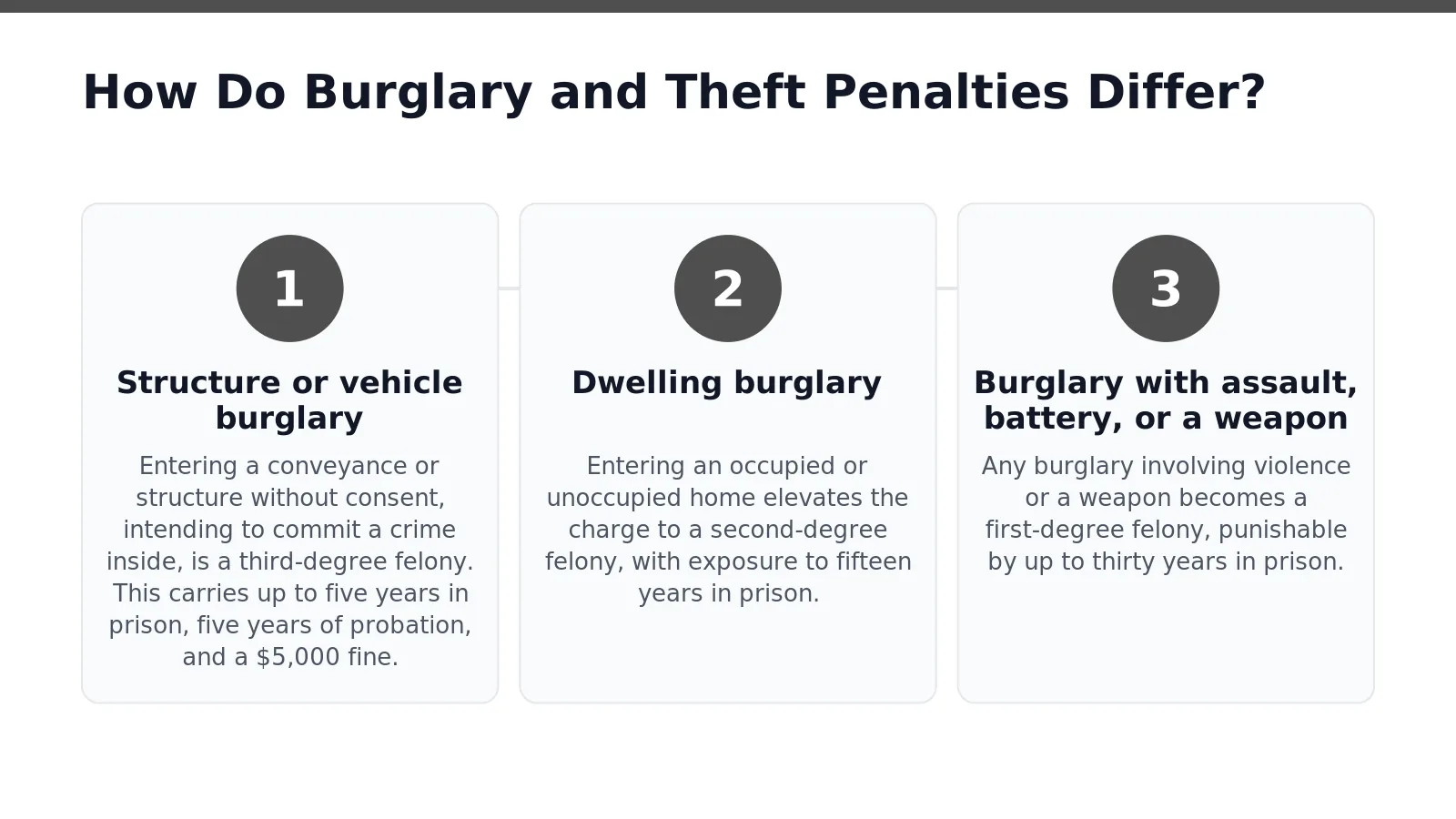
Infographic detailing felony tiers and penalties for burglary charges in Orlando.

How Do Burglary and Theft Penalties Differ?

Florida law separates burglary and theft penalties by the location involved, the property value at stake, and whether violence enters the picture. Orange County prosecutors treat these as distinct offenses, even when a single arrest in Orlando produces both charges at once. Understanding the breakdown below matters for anyone building a defense strategy or weighing a plea offer.

What penalties apply to burglary charges in Orlando?

Burglary penalties scale sharply with the type of property entered and the circumstances surrounding the entry. Three tiers exist under Florida law:

  1. Structure or vehicle burglary: Entering a conveyance or structure without consent, intending to commit a crime inside, is a third-degree felony. This carries up to five years in prison, five years of probation, and a $5,000 fine.
  2. Dwelling burglary: Entering an occupied or unoccupied home elevates the charge to a second-degree felony, with exposure to fifteen years in prison.
  3. Burglary with assault, battery, or a weapon: Any burglary involving violence or a weapon becomes a first-degree felony, punishable by up to thirty years in prison.

Theft charges follow a separate structure, calculated by property value rather than location. A felony grand theft defense orlando case often carries lower maximum exposure than dwelling or armed burglary. It still threatens a permanent felony record.

Why does overlapping burglary and theft exposure raise the stakes?

Combined charges compound sentencing risk. An Orange or Osceola County defendant facing felony property allegations alongside burglary needs an aggressive, immediate response. Each additional charge adds independent prison exposure. A seasoned burglary defense orlando attorney evaluates how these charges interact before negotiations begin. Early intervention from a property crime lawyer orlando families trust often shapes whether charges get reduced, separated, or dismissed before trial.

What Is The First Step After an Arrest?

Contacting a defense attorney within hours of an arrest in Orlando matters more than any other early decision. Silence protects a case; unplanned statements to police or detectives often damage it beyond repair. A felony grand theft defense orlando case or a pending burglary defense orlando matter can shift dramatically depending on what happens in those first hours.

For anyone arrested or under investigation in Orange County, the following sequence protects rights and preserves defense options:

  1. Stop answering investigator questions beyond basic identification.
  2. Request contact with a criminal defense attorney immediately.
  3. Schedule a confidential case evaluation, available around the clock, before an investigation or charging decision moves forward.
  4. Gather any documents, messages, or witness names connected to the arrest.
  5. Avoid discussing the case with anyone other than the attorney.

Why does calling an attorney early matter so much?

Early attorney involvement improves the odds of a thorough, successful defense, according to legal guidance on burglary, robbery, and theft charges in Florida. Prosecutors build their case from day one. A defense that starts days or weeks later works from a disadvantage that early action avoids entirely.

What happens during a free consultation?

A free consultation allows a client to walk through the facts of an arrest or investigation before committing to any next step. No obligation exists at this stage. Clients facing charges ranging from misdemeanors to serious felonies, including property offenses, meet with a defense team equipped to handle cases across the 9th Judicial Circuit.

Acting fast after an arrest rarely feels natural, especially under stress. Yet that window shapes everything that follows. A property crime lawyer orlando families trust can evaluate the arrest, identify weaknesses in the state's evidence, and begin building a defense before the case hardens against the accused.

How Can the Evidence Against You Be Challenged?

Prosecutors in Orange County must prove every element of a theft or burglary charge beyond a reasonable doubt. Each element presents an opportunity for challenge. Florida's theft statute requires proof that a person knowingly obtained or used another's property while intending to deprive the owner of it, either temporarily or permanently. That intent requirement often becomes the central battleground in a case built on circumstantial evidence or shaky witness identification.

A skilled property crime lawyer orlando families trust examines whether the state can actually prove knowledge and intent, not just possession or presence. Surveillance footage, store records, and witness statements get scrutinized line by line. Gaps in the chain of custody or inconsistent timelines can undercut even a seemingly strong case.

Does a Burglary Charge Automatically Mean a Theft Conviction?

No. Burglary charges frequently arrive alongside separate theft or grand theft counts, which multiplies potential penalties but does not guarantee conviction on either charge. Each count demands independent proof, and a burglary defense orlando strategy often targets the entry element separately from any alleged taking.

What Makes a Defense Team Effective Against These Charges?

A defense led by a former prosecutor understands how the state builds its case, including common evidentiary shortcuts and weak points. That insider perspective supports grand theft defense orlando clients who need every angle examined before trial.

Effective challenges typically follow a sequence:

  1. Review the arrest report and probable cause affidavit for inconsistencies.
  2. Demand full disclosure of surveillance footage and property valuation records.
  3. Cross-examine witness identification procedures for reliability.
  4. Contest the intent element directly, given its central role under Florida law.
  5. Pursue negotiation or dismissal when proof of knowledge or intent falls short.

A defense team fighting day and night throughout the 9th Judicial Circuit applies this strategic approach to theft and burglary cases across Orlando courtrooms.

What Role Does Prosecution Experience Play?

Prosecution experience shapes how a defense attorney reads a property crime case before the state ever files formal charges. Former prosecutor Pedro A. Matos brings insight into how Orlando prosecutors evaluate evidence and decide whether to pursue grand theft or burglary counts, alongside trial attorney Gilbert R. Arroyo. That vantage point matters most in the early stages, when charging decisions are still fluid and a well-timed argument can change the outcome.

Operating out of Orlando positions the firm to work directly within the 9th Judicial Circuit. Local court procedures, filing practices, and prosecutorial tendencies differ from other parts of Florida. A property crime lawyer orlando families trust needs familiarity with these local rhythms, not just general criminal law knowledge. Understanding how a specific courthouse handles bond hearings, plea negotiations, and case scheduling often determines how quickly a client's situation stabilizes.

Why Does Burglary Classification Change the Defense Approach?

Burglary penalties in Florida shift dramatically depending on the classification involved, whether the charge concerns a vehicle, a structure, or a dwelling. That distinction drives how a burglary defense orlando strategy gets built, since negotiating a reduction from a dwelling-level charge requires a different approach than challenging a conveyance charge. Prosecution background helps identify which classification arguments carry weight with a given office.

A consultation offers the first opportunity to examine how a charge was filed and whether it holds up.

  1. Request a free consultation to review the charging documents.
  2. Identify whether the classification matches the alleged conduct.
  3. Explore whether reduction or dismissal of a count is realistic.

This process forms the foundation of effective grand theft defense orlando representation from day one.

What Mistakes Could Weaken Your Defense?

Silence and delay cause the most damage in Orlando theft and burglary cases. Suspects who wait to speak with counsel often hand investigators time to build a stronger case before any defense strategy takes shape.

Does waiting to call a lawyer actually hurt a case?

Yes. Evidence tends to firm up fast in property crime investigations. Gaps in a timeline close quickly once detectives start interviewing witnesses. A defense team offering 24/7, confidential case evaluations exists precisely because fast-moving investigations don't pause for business hours, and losing those early hours can cost opportunities to challenge evidence before charges even get filed.

Beyond timing, several other missteps commonly undermine an Orlando defendant's position:

  • Assuming misdemeanor tactics work for felony charges. Grand theft and burglary carry far heavier consequences than petit theft, and treating them the same way overlooks the need for a strategy built specifically for felony-level exposure across the 9th Judicial Circuit.
  • Overlooking stacked charges. Burglary accusations frequently arrive bundled with separate theft or grand theft counts, and ignoring that pairing leaves part of the total penalty exposure unaddressed.
  • Talking to investigators without representation. Statements made before counsel reviews the case can close off defenses that a prepared legal team would otherwise raise.

Why does early legal involvement matter so much in theft and burglary cases?

Early involvement preserves options. Attorneys who enter a case sooner can scrutinize search procedures, chain of custody, and witness statements before memories fade or evidence disappears. A grand theft defense orlando client engages early stands a measurably better chance of a thorough, successful defense than one who waits. For anyone building a burglary defense orlando strategy or seeking a property crime lawyer orlando, the lesson is the same: delay rarely helps, and it often costs chances that can't be recovered later.

How Do You Start a Free Consultation?

Starting a free consultation requires only a phone call to discuss the facts of a grand theft or burglary arrest in Orlando. No cost or obligation attaches to this first conversation. The goal is simple: give an arrested individual or a worried family member a clear picture of what comes next before any decisions get made.

A knowledgeable property crime lawyer in Orlando reviews the arrest report, the alleged property value, and the circumstances of entry into a home, vehicle, or business. Because Florida grand theft and burglary charges carry felony-level consequences, early legal input shapes every decision that follows. Waiting too long to speak with counsel can mean missed deadlines or lost evidence.

How quickly can someone reach a defense attorney after an arrest? Phone lines stay open 24/7. A client facing arrest in Orange County does not have to wait for business hours. Calling immediately connects the caller to someone ready to evaluate the case the same night, if needed.

Does language present a barrier to getting help? No. Bilingual representation in English and Spanish means families across Central Florida understand each step, from bond hearings to arraignment, without confusion.

To begin:

  1. Call the firm directly, any hour, day or night.
  2. Describe the charge: grand theft defense in Orlando or burglary defense in Orlando.
  3. Share arrest details and any paperwork received.
  4. Ask questions in English or Spanish.
  5. Review next steps before deciding how to proceed.

FAQ

What is the difference between theft and burglary under Florida law?

Theft involves unlawfully taking property. Burglary requires unauthorized entry into a structure, dwelling, or vehicle with intent to commit a crime inside. Burglary is generally prosecuted as a felony and carries more severe penalties than standard theft.

How is grand theft defined in Florida?

Florida Statute 812.014 defines grand theft as taking property valued at $750 or more. This charge is prosecuted as a felony-level offense in Orange and Osceola County courts.

Who defends grand theft and burglary cases at The AM Lawyer, P.A.?

Pedro A. Matos, a former prosecutor, and trial attorney Gilbert R. Arroyo lead the defense team, practicing throughout the 9th Judicial Circuit. Their prosecutorial background helps them understand how the State builds its case against clients.

Conclusion

In closing, defending grand theft and burglary charges demands immediate action, local expertise, and a strategy built specifically for felony-level exposure in Central Florida courts. The difference between a strong defense and a weakened one often comes down to timing, calling for counsel the moment an arrest occurs preserves evidence, protects rights, and opens avenues that delay forecloses. Whether facing a property crime charge in Orange County or across the broader 9th Judicial Circuit, early legal intervention transforms confusion into clarity and positions a defendant for the most favorable outcome possible. Your defense starts with that first conversation.